
You can download the PDF version of this letter from this link here.
This briefing is provided by Fast Track Cymru* (FTC) in alliance with Public Health Wales (PHW) and the All-Party Parliamentary Group on HIV, AIDS and Sexual Health (APPG). It is intended for Welsh Members of Parliament, your teams and any other Parliamentarians interested in the issue. For any queries or help with constituency issues, please contact the relevant bodies at the end of the briefing.
1. How much of an issue is this in Wales?
Currently, the last accessible data for Wales from the UK Health Security Agency is for 2022 and is internally contradictory. Data quality is poor, especially around ethnicity and whether people have previously been diagnosed elsewhere or lost to follow up. Currently IT systems in the Health Boards cannot “speak” to each other; there are plans for a national data management system but this is severely delayed by funding issues.
Chlamydia and gonorrhoea have risen to almost unprecedented levels over the past few years, with young people primarily affected. There were also 101 new HIV diagnoses in Wales in 2022, a substantial increase on previous years when testing dropped, with “hot spots” in Cardiff, Newport and Swansea. The majority were heterosexually-identified, though gay and bi men continue to be over-represented and the most common age group was 35-49. Diagnoses in women continue to rise significantly.
Wales is committed to the World Health Organisation target of no new HIV diagnoses by 2030/ no related stigma. There is a Wales HIV Action Plan with clear commitments which is being progressed by clinics, PHW and FTC – see: https://www.gov.wales/hiv-action-plan-wales-2023-2026
Action: Please support and prioritise the funding and creation of the NHS national case management system and support the local application of the HIV Action Plan including local Fast Track coalitions.
2. How can people test for HIV and STIs in Wales?
Now that we know that HIV treatment prevents onward transmission, testing is the most important tool we have to end HIV. It can also bring the epidemic levels of other STIs down. There are HIV clinics in five Health Boards (not Powys or Hywel Dda) and STI clinics in all (though Powys’ is only for two days per month) which offer traditional in-person sexual health testing. However, since Covid Wales has developed a high quality discreet postal testing service, Sexual Health Wales (https://tinyurl.com/ysz4r5vc), which offers free testing at home for most STIs and blood-borne viruses. This is now the most common way of testing in Wales and has enabled a number of innovative projects to increase testing such as the Wales HIV Testing Week in November (https://phw.nhs.wales/topics/wales-hiv-testing-week/) and a pilot project in which GPs text a testing offer to all adult patients (https://fasttrack.wales/texting-4-testing/).
Unlike England and Scotland, there are currently no community-led outreach testing initiatives or self-testing services in Wales but PHW currently have a range of pilot outreach collaborations in different settings using their postal kits. Self test kits (immediate result) are not freely available in Wales but can be bought from Terrence Higgins Trust and commercial sources.
Action: Please support Wales HIV Testing Week (link above) and visit your local clinic to show support if you have one; let your constituents know about the free postal home testing kits and why HIV testing is a good idea.
3. What do young people learn about HIV and sexual health in Wales?
Since 2023 Wales has had a new, distinctive schools curriculum in which a Relationships and Sexuality Education (RSE) Code is mandatorily embedded across various subjects as an ordinary part of life. Topics are age-appropriate and focus on three main strands: relationships and identity; sexual health and well-being; and empowerment, safety, and respect. PHW and FTC have been involved in creating resources for teachers and pupils to help in the classroom as this is a key part of reducing stigma and wider public misinformation on HIV.
Unfortunately, there has been a substantial amount of misinformation, exaggeration and scaremongering about the contents of the new curriculum and you may encounter parents who are anxious due to this. For detailed information on the reality, please visit (https://tinyurl.com/mkczxdyk). FTC can also put your local schools in touch with experts in Wales if they need support in implementing the curriculum.
Action: Please support the new curriculum and familiarise yourself/your team with key aspects of it so that you can counter misinformation accurately.
4. What access do people have to PrEP, the medication that prevents HIV?
PrEP (pre-exposure prophylaxis) is the medication that prevents people who are currently HIV-negative from contracting the virus, even if they are in a relationship with someone living with HIV. Alongside the treatment that stops people with HIV from being able to pass the virus on, this is a key prevention tool (https://tinyurl.com/mwk2pj5b).
Theoretically, everyone in Wales should have access to PrEP via sexual health clinics, though some would have to travel substantial distances for it. However, in practice it is frequently only offered to, and taken up by, gay men and there has been little to no promotion of it in Wales to other people who may need it. There is also often stigma attached to taking it, as there used to be about condoms. Fast Track is planning a major online campaign to inform the public about PrEP in 2025 and there are actions in the HIV Action Plan to try and widen access e.g. via pharmacies.
Action: Please find out how easily (or not) your constituents can access PrEP and support activities to widen access and awareness of it
5. What social support is available to people with HIV in Wales?
Because of funding constraints and a lack of support to the voluntary sector from health boards across Wales, there is now very little in-country social care support for people with HIV and no Welsh-run HIV or sexual health charity presence. There is excellent online and phone support from THT (for HIV) and Brook (for sexual health) and a small amount of local services from more generalist charities and community groups. Positively UK can also offer training and support to local peer support initiatives, but there are currently few of these outside Cardiff and no national support network. There are patient support groups and health advisors in some of the clinics. These services are vital to ensure people stay in care, maintain their treatment and have positive mental health.
FTC, through its local collaborations with health and social care services and community groups, seeks to encourage development of these services in any way possible despite the severe financial constraints that the NHS, local government and charities are working under.
Action: Please visit and support any local HIV and sexual health services in your constituency (your local Fast Track can point you to them where they exist).
6. What stigma do people with HIV face in Wales?
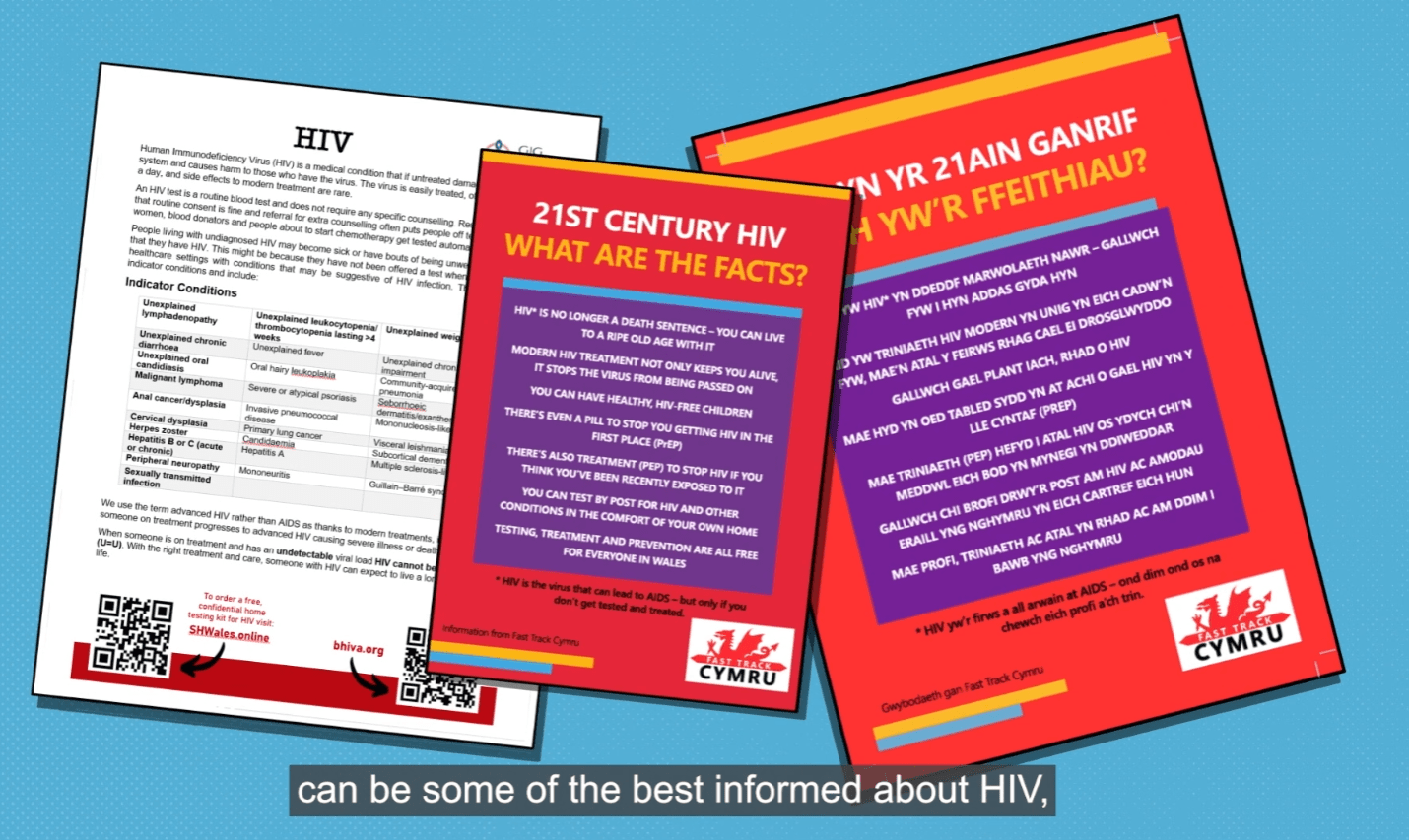
From experience, Wales has the lowest level of people living openly with HIV in Britain. A recent survey has shown poor levels of knowledge about HIV about the realities of HIV in 2024 and lingering stigma even in non-specialist healthcare staff, largely due to that poor knowledge. FTC has produced a simple language leaflet in English and Welsh which is downloadable and distributed at community events and via GP surgeries and hubs (https://fasttrack.wales/fast-track-cymru-campaign-resources/). Testing Week and other social media campaigns use community champions to normalise HIV, educate others and show support.
PHW with FTC support has recently created simple training videos for health and social care staff and a version for the public – see here: https://fasttrack.wales/animations-hiv-today/
Action: Please display a poster or leaflets in your office or at constituency surgeries showing you support people with HIV and encourage testing; participate in World AIDS Day (December 1st) and Testing Week (November) events and keep a list of helplines and support services (https://fasttrack.wales/useful-resources-and-relevant-services/) in your office files.
7. What is needed to end new diagnoses and stigma?
Essentially the answer is, get people tested, offer access to treatment and support where needed and constructively challenge ignorance and stigma.
There is much that you can do to help end HIV and its stigma and encourage better sexual health in Wales. MPs are welcome to join the HIV, AIDS and Sexual Health All Party Group (via mark.lewis@parliament.uk) and we encourage you to participate in debates on the issue. You can participate in Testing Week and World AIDS Day by sharing social media posts, speaking out or even taking a test yourself if appropriate. If your health board has a Fast Track (by mid 2025 they all will and most do already) you can support it and encourage your health board and local authorities to take appropriate action to increase testing and access to PrEP, improve social care and challenge stigma with information.
Action: Political leadership on this issue makes a huge difference – you are a role model. Please ensure your constituents are well informed.
8. Where can my constituents get help or get involved?
If you have a constituent query on HIV or sexual health, there are organisations happy to help. This list (https://fasttrack.wales/fast-track-cymru-campaign-resources/) and your local Fast Track will always be willing to signpost appropriate help.
Action: keep this list (link above) and the FTC website https://fasttrack.wales/ to hand in the office
* Fast Track Cities is a global movement, originally intended to coordinate HIV work between different parties within cities. In Wales it has been adapted to work by health board boundaries and each Fast Track contains representatives from health and social care, local authority, community organisations, researchers and people living with HIV who act co-operatively to increase awareness and improve services locally. They feed into and are coordinated by Fast Track Cymru, which is funded by the Welsh Government to support activities within the HIV Action Plan. (https://fasttrack.wales/about/)
 Fast Track Cymru